
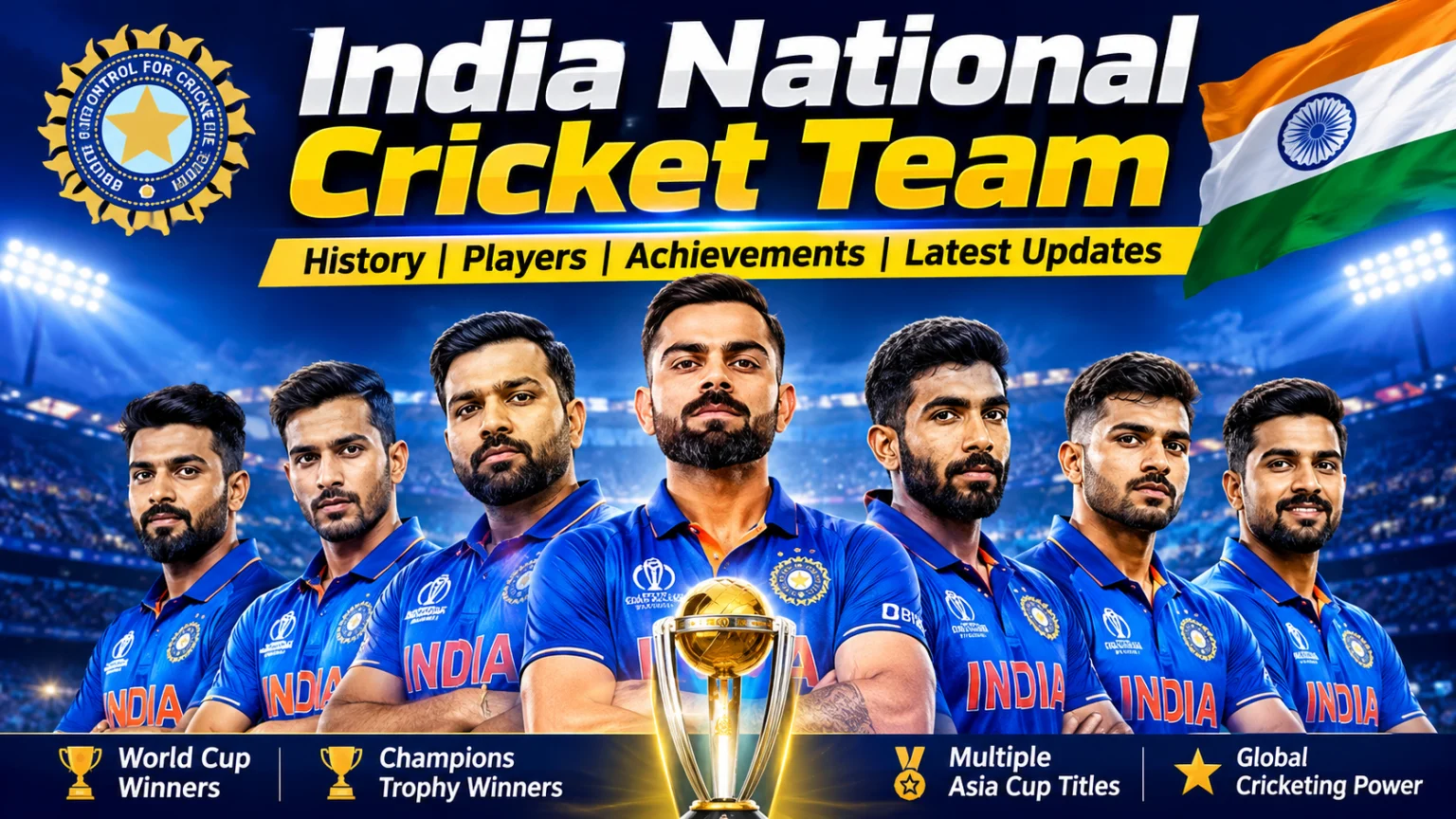
The India National Cricket Team is one of the most prominent teams in international cricket and is governed by the Board of Control for Cricket in India (BCCI). India plays all three major international formats: Test, One Day International (ODI), and Twenty20 International (T20I).
Over the decades, Indian cricket has developed from a relatively modest international side into a highly competitive team with a deep talent pool. The journey includes historic Test victories, World Cup triumphs, outstanding individual performances, and the emergence of a new generation of players.
For fans researching cricket online, match schedules, player statistics and tournament information can be useful resources. Terms such as Cricket ID and Online Cricket ID may refer to different types of digital accounts depending on the platform, so users should always understand a website’s actual purpose and terms before registering.
Introduction
Cricket in India is more than a sport. It has become an important part of the country’s sporting culture, bringing together fans from different regions and generations. From Test cricket’s traditional five-day contests to the fast-paced nature of T20 cricket, the India National Cricket Team has created countless memorable moments.
The team’s history includes legendary players such as Sunil Gavaskar, Kapil Dev, Sachin Tendulkar, Rahul Dravid, Anil Kumble, Sourav Ganguly and MS Dhoni. More recently, players such as Virat Kohli, Rohit Sharma, Jasprit Bumrah and Shubman Gill have continued to shape India’s international cricket story.
This guide explores the team’s history, major players, achievements, formats, famous venues, and how fans can follow reliable cricket information.
Question Types
When Did India Start Playing International Cricket?
India played its first Test match in 1932 against England at Lord’s in London. CK Nayudu captained the Indian side, marking the beginning of India’s Test cricket journey.
In its early years, India had limited international experience and often faced established cricket nations with considerably longer histories. Over time, however, Indian cricket developed through domestic competitions, improved infrastructure and the emergence of talented players.
The team’s progress became particularly noticeable after India began producing stronger performances overseas and developing greater depth across batting and bowling.
How Has Indian Cricket Changed Over the Years?
The evolution of Indian cricket can broadly be understood through different periods.
| Period | Major Development |
| 1930s–1950s | Establishment of Test cricket |
| 1960s–1970s | Growth of competitive Indian cricket |
| 1980s | 1983 World Cup breakthrough |
| 1990s | Rise of major batting stars |
| 2000s | Stronger overseas performances |
| 2010s | World-class batting and bowling depth |
| 2020s | Growth of a new generation and T20 influence |
Indian cricket has also benefited from a large domestic structure, including the Ranji Trophy, which has historically provided a pathway for players to progress toward international cricket.
Major Achievements of India
India has won major international tournaments and produced several historic cricketing performances.
1983 Cricket World Cup
India’s 1983 World Cup victory remains one of the most important moments in Indian sporting history.
Led by Kapil Dev, India defeated the West Indies in the final at Lord’s. The victory changed perceptions about India’s potential in international cricket and inspired a new generation of players.
2007 T20 World Cup
India won the inaugural ICC Men’s T20 World Cup in 2007 under MS Dhoni’s captaincy. India National Cricket Team
The tournament introduced a new generation to international T20 cricket and demonstrated India’s ability to compete successfully in the shortest format.
2011 Cricket World Cup
India won the 2011 ODI World Cup on home soil. The final was played at Mumbai’s Wankhede Stadium, where India defeated Sri Lanka.
The tournament was particularly memorable because Sachin Tendulkar, one of India’s greatest players, was part of the victorious squad.
2013 Champions Trophy
India won the 2013 ICC Champions Trophy under MS Dhoni. The victory added another major international trophy to India’s collection.
2024 T20 World Cup
India won the 2024 India National Cricket Team ICC Men’s T20 World Cup, defeating South Africa in the final in Barbados.
The victory was significant for a team that had experienced several years of strong performances but had also faced disappointment in major knockout matches.
India’s Famous Cricket Players
Indian cricket has produced exceptional players across generations.
Virat Kohli
Virat Kohli is widely regarded as one of the leading batters of the modern era. His international career has included major achievements across Tests, ODIs and T20Is.
Known for his intensity, fitness standards and chasing ability in limited-overs cricket, Kohli has played a major role in India’s modern cricket story.
Rohit Sharma
Rohit Sharma has been one of India’s most successful modern opening batters. His ability to score large ODI totals and his leadership in international cricket have made him an important figure in the team’s recent history.
Jasprit Bumrah
Jasprit Bumrah has India National Cricket Team established himself as one of India’s premier fast bowlers. His unusual bowling action, pace variations, yorkers and ability to bowl effectively in different phases make him a major asset across formats.
Shubman Gill
Shubman Gill represents the next generation of Indian cricket. He has developed into an important batter across formats and has also taken on significant leadership responsibilities.
His progress is particularly interesting for fans following the future direction of the India National Cricket Team.
Ravindra Jadeja
Ravindra Jadeja is an accomplished all-rounder known for his left-handed batting, left-arm spin and high-quality fielding. His ability to contribute in multiple areas has made him valuable in different match situations. India National Cricket Team
Key Indian Players and Their Roles
| Player | Primary Role | Strength |
| Virat Kohli | Batter | Run scoring |
| Rohit Sharma | Opening Batter | Aggressive batting |
| Shubman Gill | Batter | Technique and consistency |
| Jasprit Bumrah | Fast Bowler | Pace and variations |
| Ravindra Jadeja | All-rounder | Batting, bowling and fielding |
| Rishabh Pant | Wicketkeeper-Batter | Aggressive batting |
| Yashasvi Jaiswal | Opening Batter | Attacking approach |
Player selections and roles can change depending on the format, opposition, injuries and team strategy.
India’s Three Cricket Formats
Test Cricket
Test cricket remains the longest and most demanding international format.
It tests:
- Batting technique
- Patience
- Bowling endurance
- Fielding concentration
- Tactical planning
- Fitness
India has developed into a strong Test team, particularly through a combination of experienced batters and a high-quality pace attack.
ODI Cricket India National Cricket Team
ODIs provide a balance between traditional batting and limited-overs aggression. Teams generally play 50 overs per innings.
India has historically been particularly successful in ODI cricket, with World Cup victories in 1983 and 2011.
T20 International Cricket
T20Is are played over 20 overs per side and require rapid decision-making.
The format has influenced modern cricket through:
- Aggressive batting
- Specialist death bowling
- Innovative field settings
- Flexible player roles
- Greater emphasis on strike rate
India’s Cricket Stadiums: India National Cricket Team
India has numerous famous cricket venues.
Wankhede Stadium
Located in Mumbai, Wankhede Stadium hosted the 2011 World Cup final and remains one of India’s best-known cricket grounds.
Eden Gardens
Kolkata’s Eden Gardens is one of India’s most historic cricket venues and has hosted numerous international matches.
Narendra Modi Stadium India National Cricket Team
Located in Ahmedabad, Narendra Modi Stadium is one of the world’s largest cricket stadiums by seating capacity.
M. Chinnaswamy Stadium
Located in Bengaluru, the venue is known for its strong cricket culture and generally batter-friendly conditions.
Stadium characteristics can influence match strategy because pitch behaviour, weather, boundary dimensions and dew vary between venues.
How to Follow India Cricket Updates
Fans can follow the India National Cricket Team through reliable sources such as the BCCI, ICC and established sports publications. India National Cricket Team
Important information to follow includes:
- Upcoming fixtures
- Squad announcements
- Playing XI
- Injury updates
- Match results
- Player statistics
- Tournament standings
- Records and milestones
When looking for information through an Online Cricket ID, readers should distinguish between cricket news services and platforms offering financial or gaming-related services.
Cricket ID and Indian Cricket Information
A Cricket ID can be useful terminology to understand when exploring cricket websites, but it does not have one universal meaning.
Some platforms use an account to provide personalised cricket content, while other services may use the phrase in connection with sports-related activities.
If a user is researching a Best Online Cricket ID, it is important to compare: India National Cricket Team
- Website transparency
- Account security
- Privacy practices
- Available cricket features
- Customer support
- Terms and conditions
- Applicable legal requirements
The phrase “Best Online Cricket ID” should not be treated as an official certification or guarantee.
More About the India National Cricket Team
The Early History of Indian Cricket
The story of Indian cricket began long before the national team played its first official Test. Cricket was introduced to India during the British colonial period, and the sport gradually became popular in major cities. The Board of Control for Cricket in India (BCCI) was established in 1928, and India received Test status before making its debut in 1932. The Ranji Trophy was subsequently introduced in 1934, helping create a stronger domestic structure for Indian players. India National Cricket Team
India’s early international years were challenging. The team had to compete against nations with longer-established cricket systems, but the development of domestic cricket gradually produced technically strong players. Over the decades, India’s performances improved, particularly in home conditions and eventually overseas.
One of the major turning points came in the late 1960s and early 1970s. India recorded its first Test series victory outside the subcontinent against New Zealand in 1967–68. In 1971, India also achieved historic Test series victories in the West Indies and England, showing that the team could compete successfully away from home.
The 1983 World Cup: A Historic Turning Point
The 1983 Cricket World Cup changed Indian cricket forever. India National Cricket Team
India entered the tournament without being considered the strongest favourite. Under Kapil Dev, however, the team produced a series of impressive performances and reached the final against the powerful West Indies side.
India scored 183 in the final at Lord’s before bowling out the West Indies for 140. India won by 43 runs and lifted its first men’s Cricket World Cup trophy.
The achievement had a huge cultural impact. It encouraged more young people across India to take up cricket and helped accelerate the growth of the sport.
Kapil Dev’s leadership, Mohinder Amarnath’s all-round performance and the team’s disciplined bowling were among the important elements of the victory.
The Rise of Indian Batting Greats
The 1990s and 2000s introduced a generation of Indian batters who became famous worldwide.
Sachin Tendulkar became one of the central figures of Indian cricket. His career spanned more than two decades and included numerous records across international cricket. His popularity also helped cricket reach an even wider audience across India.
Other important players from this period included: India National Cricket Team
- Rahul Dravid
- Sourav Ganguly
- Anil Kumble
- VVS Laxman
- Virender Sehwag
- Harbhajan Singh
- Zaheer Khan
These players helped India become increasingly competitive across Test and limited-overs cricket.
The famous Test victories and memorable performances of this era also contributed to India’s growing reputation as a team capable of competing against the world’s strongest sides.
The MS Dhoni Era
MS Dhoni became one of the most influential captains in Indian cricket.
His leadership was particularly significant because India won the inaugural ICC Men’s T20 World Cup in 2007. Four years later, Dhoni captained India to the 2011 ODI World Cup title.
The 2011 final against Sri Lanka at Wankhede Stadium remains one of the most memorable matches in Indian cricket history. India chased Sri Lanka’s 275 with Gautam Gambhir scoring 97 and Dhoni finishing unbeaten on 91. Dhoni hit the winning six to secure India’s second ODI World Cup.
For Sachin Tendulkar, the victory was especially significant because it came after several World Cup campaigns and represented the culmination of a long international career.
Dhoni’s era also demonstrated the value of calm leadership, flexible tactics and strong wicketkeeping.
Virat Kohli and the Modern Indian Team India National Cricket Team
The next major phase of Indian cricket was strongly influenced by Virat Kohli. India National Cricket Team
Kohli developed into one of the world’s leading international batters and became known for his consistency, fitness standards and aggressive approach. His performances were particularly important in India’s Test and ODI campaigns.
The modern Indian team also benefited from improvements in fast bowling. Jasprit Bumrah, Mohammed Shami and Mohammed Siraj helped India develop a stronger pace attack capable of challenging teams in conditions outside Asia.
This development was important because Indian cricket had traditionally been associated more strongly with batting and spin bowling. A stronger pace department gave the team greater balance.
The Current Generation of Indian Cricketers
Indian cricket continues to transition between generations. India National Cricket Team
Experienced players have been joined by younger names who are developing their international careers.
| Player | Role | Key Strength |
| Shubman Gill | Batter | Technique and stroke play |
| Jasprit Bumrah | Fast Bowler | Pace and accuracy |
| Yashasvi Jaiswal | Batter | Aggressive opening |
| Rishabh Pant | Wicketkeeper-Batter | Attacking batting |
| Ravindra Jadeja | All-rounder | Batting, bowling and fielding |
| KL Rahul | Batter/Wicketkeeper | Adaptability |
| Mohammed Siraj | Fast Bowler | Pace and movement |
| Kuldeep Yadav | Spin Bowler | Wrist-spin variations |
Squads can change because of injuries, workload management, form and format-specific selection. Therefore, readers should use the BCCI’s latest squad announcements when looking for current information.
The BCCI’s current news archive shows continuing squad updates and selection announcements, including India’s 2026 tour of Sri Lanka and changes to Test squads during August 2026.
India’s Domestic Cricket System India National Cricket Team
One of the biggest strengths of the India National Cricket Team is its domestic cricket structure.
The Ranji Trophy is India’s premier first-class competition and has historically served as an important pathway for players seeking international selection. The domestic system also includes competitions such as the Duleep Trophy and Vijay Hazare Trophy.
Young players can develop their skills through:
- Age-group cricket
- State-level cricket
- Ranji Trophy
- List A cricket
- Domestic T20 competitions
- India A
- IPL
- International cricket
This system creates a large pool of players who can compete for national selection. India National Cricket Team
The IPL has also provided Indian players with extensive experience in high-pressure T20 cricket, while domestic first-class cricket remains important for developing red-ball skills.
Women’s Cricket and India’s Wider Cricket Ecosystem
Indian cricket is not limited to the men’s national team. The India women’s cricket team has also become an increasingly important part of the country’s cricket landscape. India National Cricket Team
The BCCI has invested in women’s cricket, domestic competitions and infrastructure. India’s women’s team has produced players such as Mithali Raj, Jhulan Goswami, Harmanpreet Kaur, Smriti Mandhana and many other international performers.
The wider cricket ecosystem also includes para-cricket and blind cricket. In 2026, the BCCI announced a support framework for the Cricket Association for the Blind in India, including international exposure, home-series support and access to BCCI-affiliated grounds and stadia.
This demonstrates how Indian cricket is expanding beyond the traditional men’s and women’s international teams.
Famous Indian Cricket Stadiums
India National Cricket Team India has some of the world’s most recognisable cricket venues.
Wankhede Stadium, Mumbai
Wankhede is strongly associated with the 2011 World Cup final. It is also an important venue for domestic and international cricket.
Eden Gardens, Kolkata
Eden Gardens has a long history of major international matches and is one of India’s most iconic cricket grounds.
Narendra Modi Stadium, Ahmedabad
The Narendra Modi Stadium is one of the largest cricket stadiums in the world and has hosted major international fixtures.
M. Chinnaswamy Stadium, Bengaluru
Known for its energetic atmosphere, the Bengaluru venue has hosted numerous international and domestic matches.
Arun Jaitley Stadium, Delhi
Located in the national capital, this historic venue has hosted generations of Indian cricketers and major international fixtures. India National Cricket Team
Stadium conditions matter because pitch characteristics, weather, altitude, boundary size and dew can all influence match strategy.
India’s Major Cricket Rivals India National Cricket Team
The India National Cricket Team has developed several major international rivalries.
India vs Pakistan
The India-Pakistan rivalry is one of the most watched contests in international cricket. Matches between the two teams often attract enormous global attention.
India vs Australia
India and Australia have developed a major rivalry across Tests, ODIs and T20Is. Their Test contests, particularly the Border-Gavaskar Trophy, have produced many memorable matches.
India vs England
India and England have a long history of Test cricket dating back to India’s first Test in 1932. Their modern contests regularly feature high-quality batting and bowling battles.
India vs Sri Lanka India National Cricket Team
India and Sri Lanka have played numerous bilateral and tournament matches across formats. The 2011 World Cup final between the two teams remains one of the most famous matches in their rivalry.
How Fans Can Follow India Cricket
Fans can stay updated through: India National Cricket Team
- BCCI official announcements
- ICC tournament pages
- Official team information
- Recognised sports publications
- Live score services
- Match scorecards
- Player statistics
- Verified social-media accounts
When researching a Cricket ID or Online Cricket ID, it is important to distinguish between an account designed for cricket content and an account associated with other online services.
Similarly, the phrase Best Online Cricket ID is a descriptive search term rather than an official cricket certification. Users should evaluate any platform based on transparency, privacy, security and applicable rules rather than marketing claims.
India’s Legacy and Future India National Cricket Team
The India National Cricket Team’s journey has moved through several distinct generations. From CK Nayudu and the early Test side to Kapil Dev’s 1983 World Cup winners, Sachin Tendulkar’s generation, MS Dhoni’s successful teams and the modern era featuring players such as Kohli, Bumrah and Gill, each period has contributed something important.
The future of Indian cricket will depend on continued investment in domestic cricket, coaching, player development, sports science, women’s cricket and inclusive opportunities. India National Cricket Team
With a large population of cricket followers and a deep domestic talent pool, India is likely to remain one of the central forces in international cricket.
For readers building a cricket-focused website, these historical and current details can also provide strong EEAT signals when combined with official sources, named authors, publication dates, updated statistics and clear references to authoritative cricket organisations.
India Cricket: What Makes the Team Strong? India National Cricket Team
One of India’s biggest strengths is its player depth. India National Cricket Team
The country has a large domestic cricket system, professional coaching structures and numerous competitive tournaments. This creates opportunities for young players to gain experience before moving into international cricket.
Another strength is adaptability. Indian players regularly compete in different conditions, from fast pitches in Australia and South Africa to turning surfaces in the Indian subcontinent.
The modern team also places significant importance on fitness, fielding and tactical preparation.
Frequently Asked Questions About The India National Cricket Team
Who governs the India National Cricket Team?
The India men’s national cricket team is governed by the Board of Control for Cricket in India (BCCI).
When did India play its first Test match?
India played its first Test match in 1932 against England at Lord’s.
How many major international formats does India play?
India plays Test, ODI and T20I cricket at the international level.
Who are some famous Indian cricketers?
Some prominent names from India’s cricket history include Sachin Tendulkar, Kapil Dev, Sunil Gavaskar, Rahul Dravid, Anil Kumble, MS Dhoni, Virat Kohli, Rohit Sharma and Jasprit Bumrah.
What is a Cricket ID?
A Cricket ID can refer to a digital account associated with a cricket-related platform. Its exact purpose depends on the website or service.
What is an Online Cricket ID?
An Online Cricket ID generally refers to an online account related to cricket content or services, but different platforms may use the term differently.
How should I choose a Best Online Cricket ID?
Rather than relying on promotional claims, compare security, privacy, transparency, support, features and applicable requirements.
Conclusion About The India National Cricket Team
The India National Cricket Team has developed from its Test debut in 1932 into one of the most influential teams in international cricket. From Kapil Dev’s 1983 World Cup triumph to the achievements of modern stars such as Virat Kohli, Rohit Sharma, Jasprit Bumrah and Shubman Gill, India’s cricket journey contains generations of remarkable players and memorable performances.
For cricket fans, following reliable match schedules, player statistics, team news and official announcements is the best way to stay informed. Terms such as Cricket ID, Online Cricket ID and Best Online Cricket ID should also be understood according to the specific platform using them.
For accurate and trustworthy information, readers should prioritise official cricket organisations and recognised sports sources, while checking the terms, privacy policies and legal requirements of any online platform they consider using.